
Residential wind turbines
A small wind turbine can produce electricity for a house or a smallholding, but only where the wind is steady enough. It is a niche solution that calls for an assessment of the site before any decision is made.
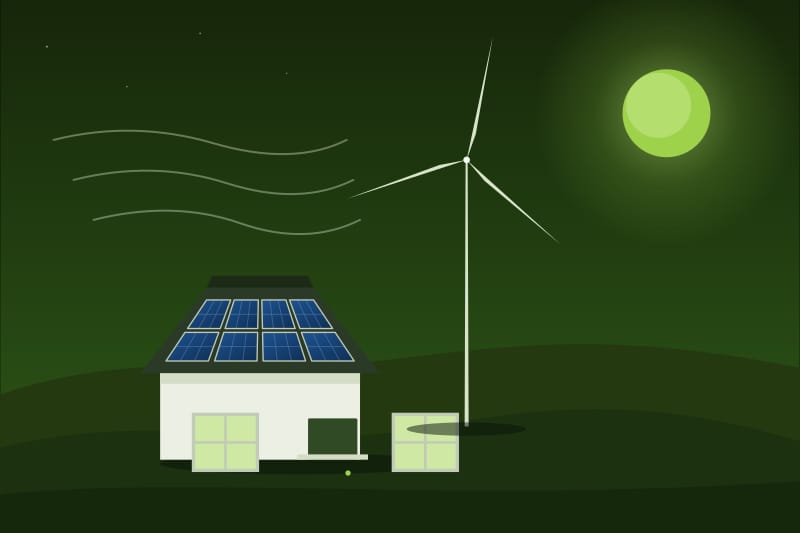
What a residential wind turbine is
It is a low-power turbine, usually between a few hundred watts and a few kilowatts, mounted on a tower next to the house or smallholding. The rotor turns the energy of the wind into electricity, which is then conditioned by a controller or an inverter and either used in the house or stored in a battery.
When a turbine makes sense
Small turbines give good results in open places with steady wind at rotor height: hills, plateaus, farmland with no obstacles around it. In built-up areas or in sheltered valleys, the wind is often too weak or too turbulent for useful output.
Every location is different. That is why we do not recommend a turbine before understanding how the wind blows where you want to install it. The article a wind turbine for your home explains in detail the questions we start from.
The wind resource, the location and the tower height
The energy in the wind rises very steeply with its speed, so small differences in average speed can change output considerably. Wind speed increases with height, and near buildings, trees and uneven ground there is turbulence, which reduces output and puts mechanical stress on the turbine. As a general rule, the tower is chosen so that the rotor sits high enough above the surrounding obstacles.
Roof mounting is generally not recommended for small turbines, because of turbulence and the vibration passed on to the structure.
Noise, vibration and distances
Turbines produce aerodynamic and mechanical noise, and the level depends on the model and on the wind speed. The distance from homes, including the neighbours’, is assessed, as is the way the tower is anchored. Approvals or permits may be needed, depending on the height and on local regulations; we check them together with you.
Hybrid solar + wind systems
In some locations the wind is more active in winter and at night, that is, when the panels produce less. Combining the two sources can smooth out output, but this is a possibility, not a rule. A battery helps keep energy from one period to the next. For the solar side, see photovoltaic panels, and for the complete architecture, hybrid solar systems.
Grid-connected or off-grid
A turbine can work in grid-connected systems, through a compatible inverter, or in stand-alone systems, with a battery and a charge controller. The equipment has to be matched to the turbine, and in the grid-connected version the same grid connection requirements apply as for photovoltaic panels.
Why the site assessment matters
We do not make promises about output without information about the location. We discuss the area, the obstacles, the possible tower height, your consumption and the alternatives. If photovoltaic panels are a better fit for your situation, we tell you so clearly.
See also
Useful articles
Frequently asked questions
Is a wind turbine worth it for a house?
Only if the site has good, steady wind at rotor height. In many built-up or sheltered locations, photovoltaic panels are a safer choice. We recommend an assessment before you decide.
Is a turbine noisy?
It can be, depending on the model and the wind speed. The distance from buildings is taken into account and the product specifications are checked.
Can I mount the turbine on the roof?
It is generally not recommended, because of turbulence and vibration. Small turbines are usually mounted on a separate tower.
Can it be combined with photovoltaic panels?
Yes. Hybrid solar–wind systems can work together, with an inverter or controller and, optionally, a battery.
Shall we talk about your project?
Tell us your town and roughly how much you use. We will suggest the next steps.