
Photovoltaic panels for homes and smallholdings
Photovoltaic panels turn sunlight into electricity you can use directly in the house. This page explains, without needless jargon, how a system works, what matters about the roof, and what we establish together before a quote.
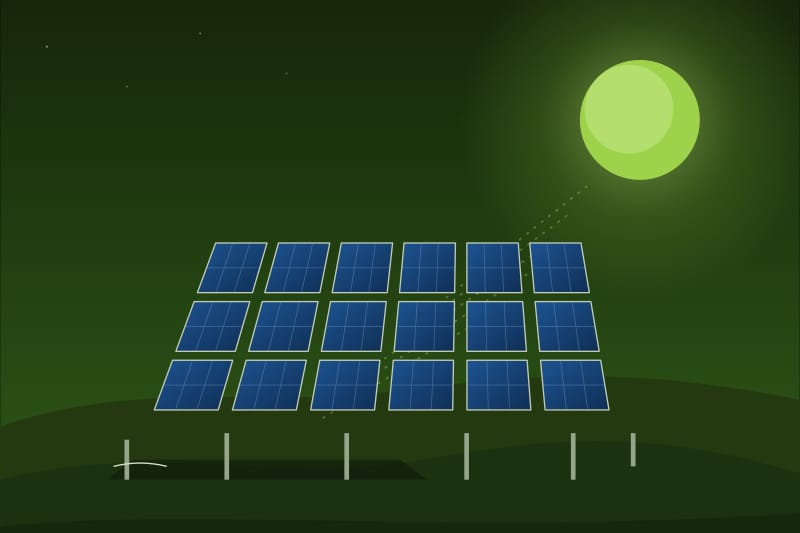
What a photovoltaic panel does
A photovoltaic panel contains silicon cells that produce direct current when light falls on them. The current passes through an inverter, which turns it into the alternating current the appliances in the house use. While the system is producing, the house first uses its own energy; the surplus can charge a battery or, if the installation is connected for that purpose, can go to the grid.
Panels also produce in cloudy weather, but less than on clear days. Output depends on the light available, not on the outdoor temperature.
Types of panel: monocrystalline, polycrystalline, thin film
For houses and smallholdings, monocrystalline panels are the most common: they have good efficiency per square metre, behave well in weak light and take up less room on the roof. Polycrystalline panels were for a long time the cheaper alternative, but they are increasingly rare in current offers. Thin-film technologies appear mainly in special projects, where weight or the shape of the surface calls for something else.
Efficiency and nominal power
Efficiency shows how much of the light received becomes electricity; for current monocrystalline panels it is usually around 20–23%. Nominal power is expressed in watt-peak (Wp) and is measured under standard laboratory conditions; for houses, panels are frequently between 400 and 450 Wp.
Higher efficiency does not automatically make the system better. What counts is the relationship between the space available, the budget and your consumption, and the exact figures should be read from the data sheet of the product proposed.
Roof orientation and tilt
In Romania, a south-facing roof tilted at around 30–35° usually produces best over a full year. South-east and south-west orientations lose a little annual output, and an east–west layout can suit a household whose consumption is concentrated in the morning and the evening. A north-facing slope is rarely a good choice.
Shading and temperature
The shadow of a chimney, a tree or a neighbouring building can reduce output by more than the shaded area would suggest, because panels are connected in strings. That is why we look at the shadows across the day and, where it makes sense, discuss optimisation at panel level.
Temperature matters too: in high heat, efficiency falls slightly, usually by 0.3–0.4% for every degree above 25 °C at the cell. Ventilation behind the panel helps.
How much a system produces in a year
Annual output, measured in kWh, depends on the installed power, orientation, tilt, shading and geographic area. Summer output is much higher than winter output, and a sound calculation takes that variation into account.
We do not start from general promises, but from your consumption and from the roof you have. You can make a first estimate with the indicative calculator; the final figure remains subject to a technical analysis. More in the article on how much a photovoltaic system produces.
Sizing the system
Sizing starts from annual consumption on the bills, from the times of day when you use energy, from the usable roof area and from the purpose of the system: reducing the bill, a reserve for power cuts, or both. A bigger system is not always better, because energy consumed directly is worth more than surplus, and the rules for grid connection and for surplus can change. We check the requirements in force at the time of the quote.
For a sound quote we need:
- monthly consumption in kWh, or a few recent bills;
- the type and condition of the roof (tile, sheet metal, flat roof, timber frame) and its orientation;
- the large appliances: heat pump, air conditioning, electric water heater, electric car;
- whether you want a battery or a reserve for power cuts.
The inverter, the batteries and the grid connection
The inverter is the component that runs the system. A grid-tied inverter works only while the grid is present; a hybrid inverter can also manage a battery and, in certain configurations, can power part of the house during a power cut. The choice depends on your objectives.
Storage configurations are explained on hybrid solar systems and battery storage. Connecting as a prosumer goes through the distribution operator and requires the documentation it asks for.
Self-consumption matters
Energy used at the moment it is produced brings the clearest benefit. Moving some loads into the sunny hours (water heater, washing machine, heat pump) and monitoring consumption can count as much as the number of panels.
Maintenance and service life
Panels have no moving parts and need little maintenance: periodic checks of the structure and the cabling, following the output and, where needed, cleaning (rain washes off some of the dirt, but dust or pollen can settle, especially at shallow tilts).
Manufacturers generally offer performance warranties of 25–30 years, though the conditions differ from product to product. The inverter usually has a shorter service life than the panels and may need replacing during the life of the system.
What the cost depends on
- the installed power and the number of panels;
- the type of panel and of inverter;
- whether there is a battery, and its capacity;
- the type of roof and the mounting structure;
- the length of the cable runs to the consumer unit;
- the protection and monitoring equipment;
- the documentation and the grid connection.
We do not publish general prices, because they would not be honest in every situation. We send you a tailored quote after we have looked at your figures.
How Novoltica helps
We look at your consumption, propose a suitable configuration and explain the choices, including the simpler options. If you would rather have a ready-defined package, see solar kits. We work in Bacău, Bucharest, Ilfov and Suceava.
See also
Useful articles
Frequently asked questions
How many photovoltaic panels do I need?
It depends on annual consumption, on the roof orientation and on the purpose of the system. As a worked example: at a consumption of 3,600 kWh a year and an assumed output of about 1,100 kWh per kWp in a year, the result would be roughly 3.3 kWp, that is 8 panels of 400 Wp. It is only a worked example; real sizing takes account of the consumption profile, the roof and the budget.
Can I use photovoltaic panels in winter?
Yes, but they produce less: the days are short, the sun is low, and snow can cover the surface. The system is sized on the annual average, not on the weakest month. More in the article on photovoltaic panels in winter.
What happens when there is no sun?
At night or in very cloudy weather, the house draws on the grid or, if the system has a battery, on the stored energy. The switchover is automatic; you do not have to do anything.
Is a battery necessary?
Not always. It makes sense above all when you use a lot in the evening or want a reserve for power cuts. The difference is explained on the page about battery storage.
How long does a photovoltaic system last?
Panels generally carry performance warranties of 25–30 years; the inverter may need replacing sooner. The real lifespan depends on the quality of the equipment and of the installation.
Shall we talk about your project?
Tell us your town and roughly how much you use. We will suggest the next steps.