
Hybrid photovoltaic systems: panels, battery and grid
A hybrid system combines photovoltaic panels, a hybrid inverter, a battery and the grid connection. The energy produced first supplies the house, then charges the battery, and the grid makes up whatever is missing. The diagram below shows the flows in three situations.
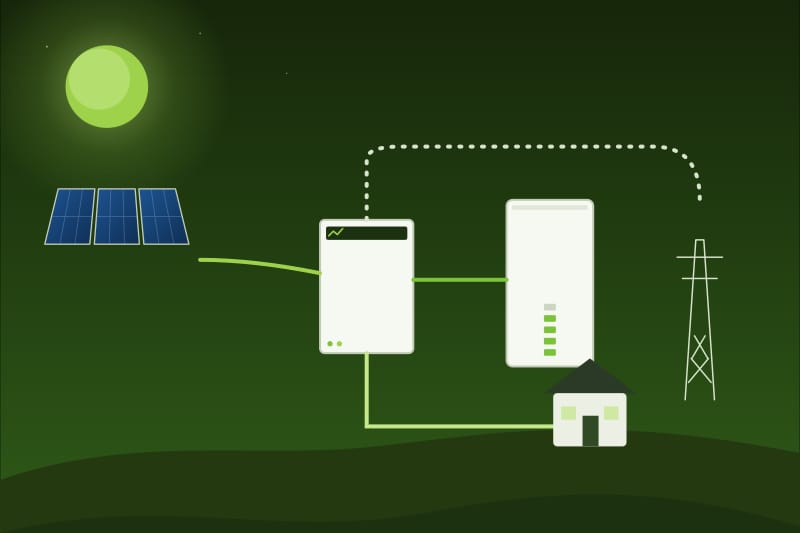
How energy flows in a hybrid system
Sunny day: the panels supply the house, the surplus charges the battery and, if the installation is configured for it, can go to the grid.
Choose a situation in the diagram. Without JavaScript, all three situations are described in the list below.
- Sunny day: the panels supply the house; the surplus charges the battery and, once the battery is full, the energy can be sent to the grid, if the installation is configured for that purpose.
- Evening and night: the house draws on the battery; if the battery has run down to the set limit, the house draws on the grid.
- Grid outage: only if the system has a backup function and a backup circuit does part of the house continue to be supplied from the battery and the panels.
The components of the system
The photovoltaic panels
They produce direct current. Details under photovoltaic panels.
The hybrid inverter
It turns direct current into alternating current, manages battery charging and decides, according to its settings, where the energy being used comes from. More explanation in the article the hybrid inverter.
The battery
It stores energy for later. See battery storage.
The electricity grid
It covers demand when output and the battery are not enough, and can take the surplus, within the limits set by the distribution operator.
What backup means in a hybrid system
A hybrid system does not automatically provide energy during a power cut. Backup depends on the inverter model, on whether there is a dedicated backup output and on how the house’s circuits are wired. Usually only some of the loads are supplied, chosen together with you. Without this configuration, the inverter shuts down for safety reasons when the grid fails.
Operating modes
Hybrid inverters offer several modes, such as giving priority to self-consumption, keeping a minimum reserve in the battery, or charging from the grid at certain times. The right settings depend on your consumption habits and can be adjusted over time by following the data in the monitoring app.
When a hybrid system makes sense
- you use a lot of energy in the evening and want to use more of the energy you produce;
- you need a reserve for essential loads;
- you want to be able to add storage in stages;
- you are working in the long term towards independence from the grid, without expecting complete independence.
If most of your consumption is during the day, a system without a battery may be enough. We say so openly in the quote.
See also
Useful articles
Frequently asked questions
What is a hybrid inverter?
It is an inverter that can work with the panels as well as with a battery and the grid. It manages output, storage and consumption in a single piece of equipment.
Does a hybrid system work during a power cut?
Only if the equipment has a backup function and the installation is built with a backup circuit. Without these, the inverter shuts down when the grid goes down.
Can I start without a battery and add one later?
Yes, if you choose a hybrid inverter or a storage-compatible inverter from the start. We check this at the design stage.
What is the difference between hybrid and on-grid?
An on-grid system sends energy to the house and the grid, without storage. A hybrid system adds a battery and, in certain configurations, backup.
Shall we talk about your project?
Tell us your town and roughly how much you use. We will suggest the next steps.