
Batteries for storing solar energy
A battery keeps the energy produced during the day for the evening, the night or a power cut. It is not essential in every project: it is worth considering when you use a lot of energy after sunset or want a reserve of energy in the house.
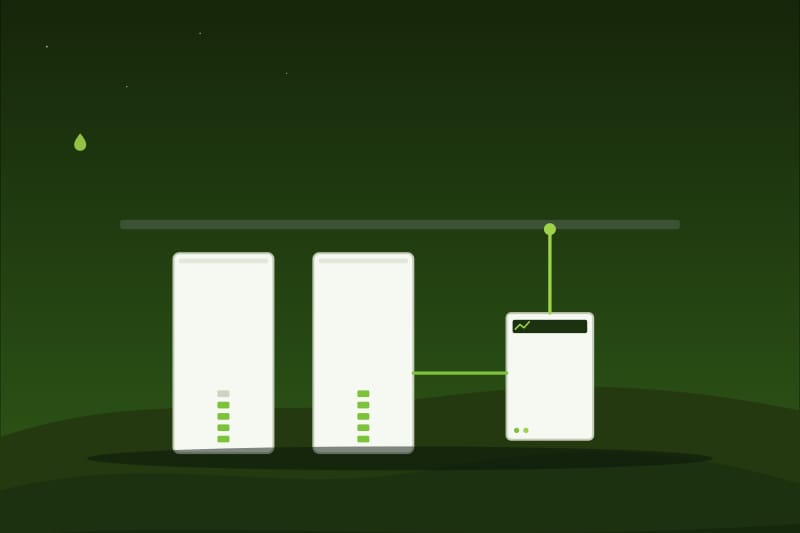
Why batteries are used in a photovoltaic system
Panels produce most around midday, while many households use most early in the morning and in the evening. Without storage, energy that is produced but not used at that moment goes to the grid or is not put to use at all. A battery shifts part of the daytime output to the hours when you need it.
- higher self-consumption: you use more of the energy you produce yourself;
- evening consumption: lighting, appliances and electric heating run from the battery;
- a reserve during power cuts: if the system has a backup function, certain circuits can stay powered.
Backup during outages: what needs to be clarified
Not every battery provides an automatic reserve. It depends on the inverter and on whether there is a dedicated backup circuit, often called EPS or backup. The battery has limited power and capacity, so we establish from the outset which loads you want to keep powered: the fridge, the lighting, the heating boiler, the well pump, the router.
Large loads, such as an electric hob or the oven, may exceed the power the system can deliver in backup mode.
Nominal capacity and usable capacity
Capacity is expressed in kWh. Nominal capacity is the total declared value; usable capacity is the part you can actually use without going below the limit allowed by the manufacturer. Always compare usable capacity, not just the figure in the product name.
Separate from capacity is the battery’s power, in kW: it shows how many appliances you can supply at the same time. A battery with a large capacity and low power discharges slowly, while one with high power can start demanding loads more easily.
Depth of discharge and number of cycles
Depth of discharge (DoD) shows what percentage of the capacity can be used in one cycle. A cycle means one charge and one discharge. The number of cycles guaranteed by the manufacturer, together with the warranty conditions, says a lot about the expected service life. Read the data sheet and the warranty conditions of the specific product, because the values differ widely between models.
Lithium technologies
Lithium batteries are the most widely used in residential systems. Two chemistries come up often: lithium iron phosphate (LFP), valued for its thermal stability and high number of cycles, and variants based on nickel manganese cobalt (NMC), which have a higher energy density and are therefore more compact.
We do not recommend one technology in general. The choice depends on the specific product, the warranty, the installation location and compatibility with the inverter, and these details are discussed in the quote.
Compatibility with the hybrid inverter
The battery has to match the inverter: the operating voltage (low or high), the communication protocol and the current limits all matter. Not every battery works with every inverter. For the complete architecture, see hybrid solar systems and solar systems with batteries.
How a battery is sized
We start from the energy you use after sunset and from the loads you want to keep running during a power cut. Then we check whether daytime output can charge the battery. A worked example: if you normally use 6 kWh between evening and morning and need only that energy from the battery, a usable capacity of around 6–8 kWh is a reasonable starting point.
Many batteries are modular, so the capacity can be extended later if the inverter allows it. More detail in the article which battery for a photovoltaic system.
Installation and safety
Batteries are installed in a sheltered place, at temperatures within the range recommended by the manufacturer, with suitable electrical protection and access for servicing. Installation and connection are carried out by qualified staff, in line with the product instructions and the regulations in force.
See also
Useful articles
Frequently asked questions
Is a battery necessary?
No. A system without a battery can reduce what you draw from the grid during the sunny hours. A battery becomes useful when you use a lot of energy in the evening or want a reserve during power cuts.
How long can a battery power the house during a power cut?
It depends on the usable capacity and on the consumption of the appliances left running. A worked example: 10 kWh of usable capacity and loads of about 500 W would in theory mean roughly 20 hours; with larger loads, the time falls proportionally.
Can a battery be added to an existing system?
Often yes, but it depends on the inverter you already have. Sometimes an inverter-charger is added for the battery, or the inverter is replaced. We check compatibility before the quote.
What does usable capacity mean?
It is the part of the total capacity you can actually use without going below the limit set by the manufacturer.
Shall we talk about your project?
Tell us your town and roughly how much you use. We will suggest the next steps.